Published on November 02, 2026
Proforma Invoice vs. Commercial Invoice: Key Differences and Examples
A proforma invoice comes before the sale; a commercial invoice is the final bill that travels with the goods. Here is how they differ, with an example.
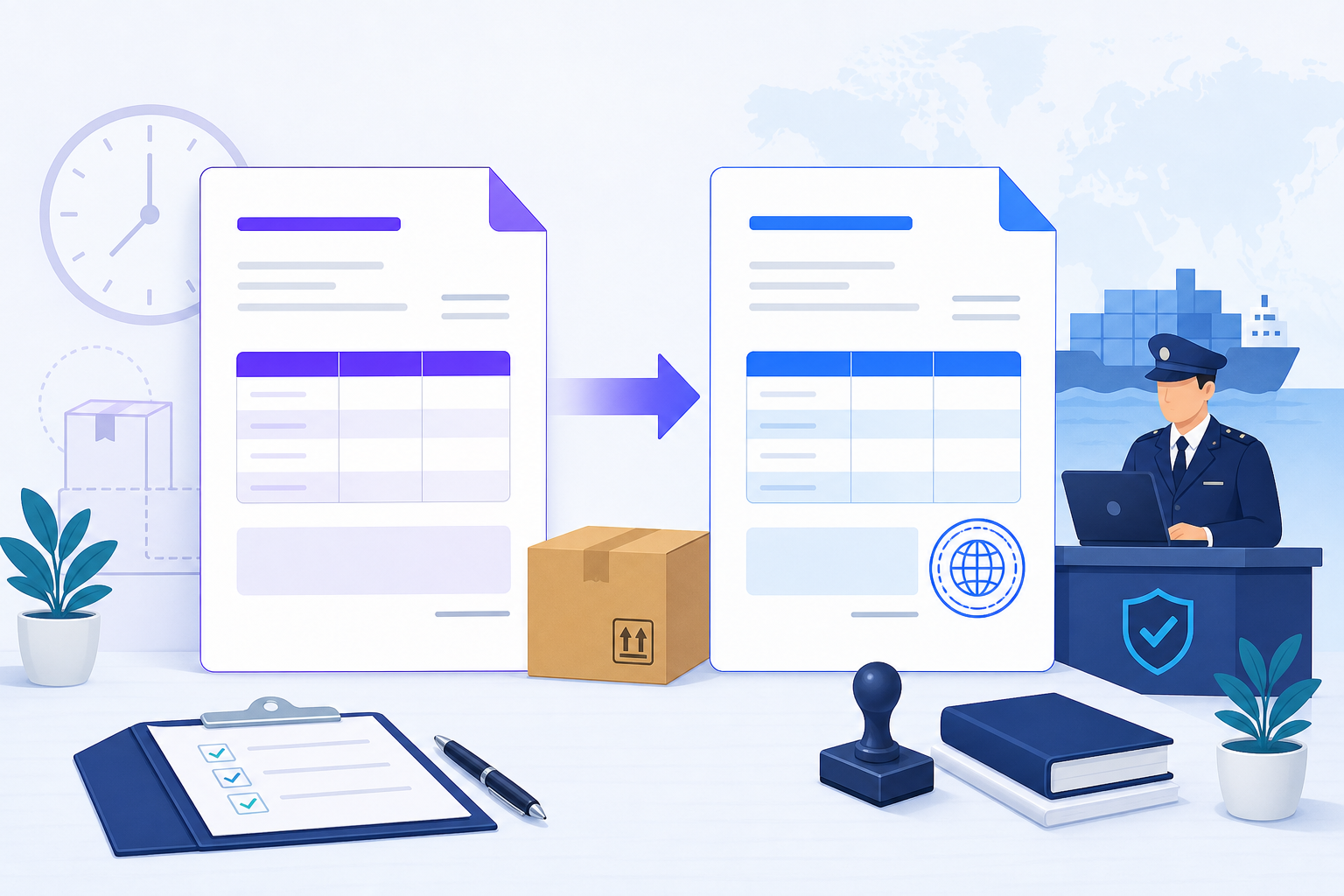
A proforma invoice and a commercial invoice often contain the same items, prices and parties, so it is easy to mix them up. The difference is when each one is issued and what it is used for: the proforma comes before the sale is completed, and the commercial invoice is the final bill that travels with the goods. Using the wrong one can delay a shipment at customs or confuse a buyer about what they owe.
Key takeaways
- A proforma invoice is a preliminary quote in invoice format. It is not a request for payment.
- A commercial invoice is the final, binding invoice for an international shipment. Customs uses it to assess duties and taxes.
- The proforma is issued before shipping; the commercial invoice is issued when the goods are ready to ship.
- A regular invoice and a commercial invoice are both final bills. “Commercial invoice” is the term used in international trade.
The short answer
Use a proforma invoice to tell the buyer what they will get and what it will cost, so they can approve the purchase, open a letter of credit, pay a deposit or apply for an import license. Use a commercial invoice to bill the buyer for what you actually shipped, and to declare the goods to customs. If you want the full background on the first document, read what a proforma invoice is.
Proforma invoice vs. commercial invoice, point by point
- Purpose: the proforma confirms the terms of a future sale. The commercial invoice records a completed sale and requests payment.
- Timing: the proforma is sent after the quote is accepted and before production or shipping. The commercial invoice is issued at shipment.
- Payment: nothing is owed on a proforma. The commercial invoice creates the payment obligation.
- Accounting: the proforma is not recorded as revenue. The commercial invoice goes into accounts receivable.
- Customs: some countries accept a proforma to pre-clear goods or estimate duties, but the commercial invoice is the official customs document.
- Accuracy: the proforma shows estimated quantities and values. The commercial invoice must match the goods in the box exactly.
- Numbering: keep proformas in a separate series (PF-0001). Commercial invoices follow your normal invoice numbers.
What a commercial invoice must include
Because customs relies on it, a commercial invoice needs more detail than a typical domestic invoice:
- Seller (exporter) and buyer (importer) names, addresses and tax or customs IDs.
- Invoice number and date.
- A detailed description of each product, with quantity, unit price and total value.
- The Harmonized System (HS) code and country of origin of each product.
- Gross and net weights, number of packages and package type.
- Currency of the sale and Incoterms (for example, FOB or DAP), which say who pays freight, insurance and duties.
- Payment terms and, when relevant, the letter of credit number.
- A declaration that the information is true and correct, with a signature.
An example of both documents in one sale
A coffee roaster in Seattle agrees to sell 500 kg of roasted coffee to a café chain in Vancouver.
- Proforma invoice PF-0108: 500 kg × $18.00 = $9,000.00, freight estimated at $450.00, Incoterm DAP Vancouver, 30% deposit to confirm, valid for 15 days. The buyer uses it to approve the purchase and pays the deposit.
- Commercial invoice INV-2291: issued on the shipping date for the 480 kg actually packed (one batch fell short): 480 kg × $18.00 = $8,640.00 plus $450.00 freight. It lists the HS code, origin, weights and packages, and travels with the shipment for Canadian customs. The deposit is applied to this invoice and the balance is due on delivery.
Notice that the amounts changed between the two. That is normal, and it is exactly why customs relies on the commercial invoice, not the proforma.
Common mistakes
- Shipping with only a proforma. Unless the destination country explicitly allows it, the goods can be held until a commercial invoice is provided.
- Using the same number for both. It makes reconciliation harder and can look like a duplicate invoice.
- Copying the proforma without updating it. If quantities, weights or prices changed, the commercial invoice must reflect the real shipment.
- Leaving out Incoterms or origin. Missing data is one of the most common causes of customs delays.
How to create both for free
With the ZenInvoice free invoice generator you can prepare both documents without signing up. Change the title to “PROFORMA INVOICE” or “COMMERCIAL INVOICE”, use the right number series, list each product as a line with its quantity and unit price, and add Incoterms, HS codes, origin and weights in the notes. Then choose a template and download the PDF. For a step-by-step walkthrough of the first document, see how to make a proforma invoice.
Frequently asked questions
Is a proforma invoice the same as a commercial invoice?
No. A proforma invoice is a preliminary document sent before the sale, and a commercial invoice is the final bill used for payment and customs.
Can I use a proforma invoice for customs?
Some countries accept a proforma temporarily, for example for samples or when the final value is not yet known, but you will usually need to provide the commercial invoice later. Check the rules of the destination country or ask your freight forwarder.
Do I need a commercial invoice for domestic sales?
No. For sales inside the country, a regular invoice is enough. The commercial invoice is specific to cross-border shipments.